

Deep Foundations and Data-Driven Ground Models: The Role of DAARWIN in Modern Geotechnical Investigation
Deep foundations demand a precise understanding of the ground. Piles, barrettes, and diaphragm walls must be designed on the basis of subsurface conditions that are often complex, heterogeneous, and difficult to characterize. Traditionally, geotechnical investigation for deep foundations has relied on borehole logs, in-situ test data, and laboratory reports scattered across spreadsheets and PDFs. While these provide snapshots of ground conditions, they rarely translate into dynamic models that evolve with design and construction.
DAARWIN software transforms this process by turning fragmented geotechnical data into living ground models. By consolidating information, automating interpretation, and enabling real-time updates, DAARWIN provides engineers with the clarity needed to design deep foundations with greater reliability and efficiency.
From Raw Data to Living Ground Models
For deep foundation projects, the reliability of the ground model directly impacts safety and cost. Conventional workflows require engineers to manually compile and interpret data from multiple sources, a process that introduces inefficiencies and inconsistencies. DAARWIN unifies public and private records, historical reports, and new project-specific data into a single geotechnical information system.
This integration allows engineers to progress from raw geological layers to well-defined geotechnical units, producing a subsurface model that is both accurate and transparent. For foundations bearing on variable soils or extending to great depths, such clarity is essential in reducing uncertainty and minimizing overdesign.
Instant Visualization of Investigation Results
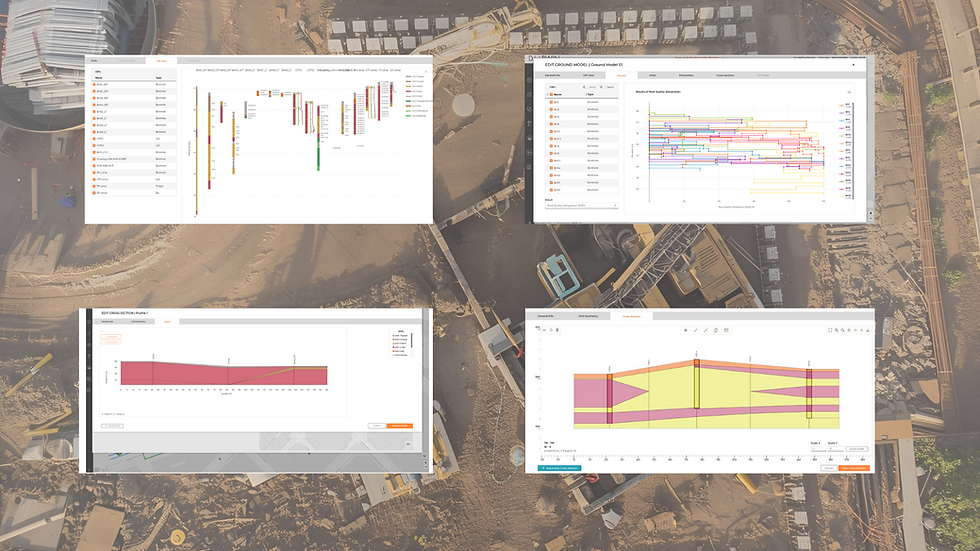
A major challenge in deep foundation design is understanding how test results align across the site. DAARWIN allows engineers to instantly visualize a wide range of investigation data — blow counts, soil identification, strength and stiffness parameters, and groundwater levels.
Rather than reviewing data in isolation, results are presented directly in digital profiles and cross-sections. This immediate visualization accelerates interpretation, helping engineers detect anomalies, validate pile test results, and align foundation design with observed site conditions. For projects where construction timelines are tight, this rapid feedback is critical.
Automated Parameter Characterization
Accurate parameter selection is fundamental for pile and retaining wall design, yet it remains one of the most complex aspects of geotechnical analysis. DAARWIN addresses this by automatically characterizing soil properties and recommending values for different constitutive models. This ensures that numerical analyses of deep foundations begin with inputs that are consistent, traceable, and based on observed test results.
Importantly, DAARWIN also allows engineers to customize the formulas used in parameter calculations. This flexibility enables adaptation to project-specific requirements or regional standards, ensuring that deep foundation models reflect both local practice and site-specific behavior. By combining automation with customization, DAARWIN reduces subjectivity and provides more reliable parameters for settlement and load-bearing assessments.
Cross-Sections and Integration with PLAXIS
Deep foundation projects require close integration between investigation data and numerical modeling. DAARWIN streamlines this process by generating detailed cross-sections directly from its centralized database. These digital ground models can be exported seamlessly into advanced analysis software such as PLAXIS, ensuring a consistent link between site investigation, model preparation, and design.
This connection eliminates manual redrafting and reduces the risk of errors, while giving engineers a clear, defensible workflow that supports complex deep foundation design.
Improving Accuracy in Settlement Predictions
One of the most critical concerns in deep foundation engineering is differential settlement. Traditional methods, which rely on static assumptions, often fail to capture how ground behavior evolves during construction. DAARWIN continuously links investigation data with live ground models, improving the accuracy of settlement predictions.
As new monitoring data becomes available, soil stiffness, strength, and groundwater levels can be updated in real time. This ensures that predictions remain aligned with observed performance, allowing engineers to adjust foundation design or construction methods before costly issues arise.
Why DAARWIN Outperforms Traditional Methods
Compared to conventional workflows, DAARWIN provides clear advantages for deep foundation projects. Manual processes that once took weeks can now be completed in hours. Engineers no longer rely on fragmented reports but work within a centralized geotechnical database that supports every stage of design.
Automated parameter characterization ensures consistency, while customizable formulas give engineers control to adapt calculations to their project context. Cross-sections link directly to numerical modeling, creating a transparent connection between raw data and design decisions. This combination of automation and flexibility enhances collaboration, reduces uncertainty, and results in safer, more efficient foundation solutions.
Conclusion: A New Standard for Deep Foundations
Geotechnical investigation is no longer just about collecting data; it is about transforming that data into actionable models that guide safe and economical design. With DAARWIN, investigation becomes a continuous, data-driven process that adapts as projects evolve. Engineers gain confidence in their ground models, while project teams benefit from optimized foundations, reduced rework, and minimized risk.
For firms involved in deep foundation engineering, DAARWIN is not simply an innovative tool — it is becoming the new standard for modern geotechnical investigation.
Discover how DAARWIN can redefine the way you approach deep foundation design. Book a demo today and experience the power of data-driven ground models firsthand.


